Small Budgets, Big Targets: Fraud Risks to Nonprofits and Small Businesses
What the ACFE’s 2026 Report to the Nations Means for Nonprofits and Small Businesses
The Association of Certified Fraud Examiners (ACFE) has released Occupational Fraud 2026: A Report to the Nations, its 14th and largest global study on workplace fraud, drawn from 2,402 real cases across 143 countries. Collectively those cases caused more than $3.4 billion in losses, with a median loss of $104,000 per case and a typical scheme running 12 months before it was caught. For nonprofits and small businesses, the report carries a pointed message: limited size is not a shield and, in several respects, it is a liability.
Size Does Not Protect You
One of the most counterintuitive takeaways is how little organizational size influences the likelihood or the cost of fraud. Small and large organizations experience fraud at comparable rates, and their median losses are strikingly similar.
| Organization Size | Share of Cases | Median Loss |
|---|---|---|
| Fewer than 100 employees | 22% | $126,000 |
| 10,000+ employees | 26% | $123,000 |
| Under $50M in revenue | 37% | $100,000 |
| $1B+ in revenue | 29% | $145,000 |
The pattern is clear: organizations with fewer than 100 employees actually posted a slightly higher median loss ($126K) than organizations with more than 10,000 employees ($123K). While not the highest-loss category in every measure, the data suggests that smaller organizations remain particularly vulnerable to occupational fraud and can experience losses comparable to, or even exceeding, those of much larger organizations. The reason is structural: smaller organizations concentrate financial duties in a few trusted people, leaving thin segregation of duties with fewer independent checks, and less resources available for more robust preventative and detective measures.
The Detection Gap
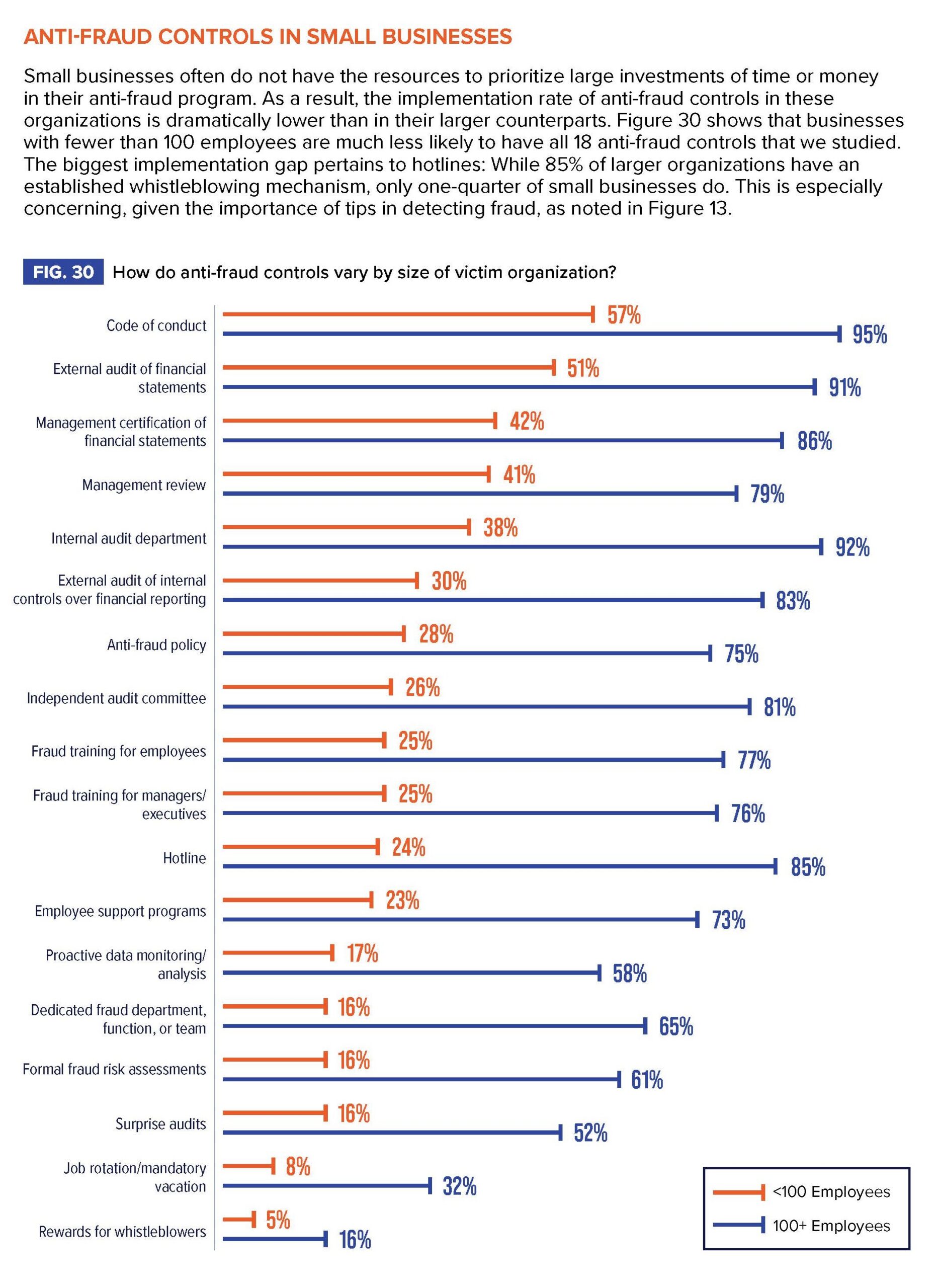
Across all cases, the three most common ways fraud is caught are tips (43%), internal audit (15%), and management review (13%); tips alone catching nearly three times as many schemes as the next method. Yet the report’s controls analysis (see Fig. 30) shows small businesses are consistently less likely to have the very controls that power these detection methods: formal reporting hotlines, an internal audit function coupled with surprise audits, and independent management review. The result is a detection gap in which the organizations most exposed to loss are the least equipped to catch fraud early, which is precisely why their schemes run longer and cost more.
Source: ACFE
The call is coming from inside the C-suite
The biggest control failures aren’t at the front desk, they’re moving up the org chart. More than half of all fraud cases involved missing or overridden internal controls, and the profile of who’s committing fraud has quietly flipped. In 1996, staff-level employees committed 58% of frauds, managers 30%, and owners/executives just 12%. By 2026, staff and managers each account for 41%, and owners/executives have climbed to 16%. That upward drift matters because severity scales with authority: executive-led schemes cause roughly 9x the loss of a staff-level scheme, since the people who can approve transactions are also the ones who can bypass the checks on them. The everyday exposure is still mundane: asset misappropriation (cash, payroll, expense reimbursement) appears in ~90% of cases. The takeaway isn’t “distrust your leaders,” it’s that “tone at the top” has graduated from a soft governance idea into a measurable, top-severity risk that deserves a real control.
Training Cuts Fraud Duration For Nonprofits and Small Businesses Alike
Because a longer scheme is a costlier scheme, anything that shortens duration directly reduces loss. The report quantifies the stakes: fraud caught within six months carries a median loss of roughly $40,000, while schemes that run more than five years exceed $1.1 million. Fraud awareness training is one of the most cost-effective levers for compressing that timeline.
At nonprofits, the effect is dramatic
- Employee-led schemes: median duration falls from 18 months to 8 months when awareness training is in place.
- Manager-led schemes: median duration falls from 15 months to 8 months.
For small businesses, the upside is even greater
Small businesses have the most to gain because they start from the weakest baseline. The report ties over half of all fraud cases to missing or overridden internal controls, a gap that hits small organizations hardest, and small businesses are consistently the least likely to have fraud awareness training in place. Since they also carry the highest median losses of any organization size, closing that training gap delivers an outsized return: earlier detection on the exact schemes that would otherwise run longest and cost the most. For a lean organization, a single avoided six-figure loss can equal a full year of profit. In both settings training works the same way: it turns employees into detectors who know what a red flag looks like and how to report it, reinforcing the tips channel that already catches 43% of fraud.
What this means for…
The upward shift in fraud risk doesn’t land the same way on every desk. Because severity scales with authority, each layer of the organization has a distinct role to play in closing the gap:
- C-Suite and Operations Teams: Set the tone at the top and strengthen the control environment — reinforce segregation of duties and back it with clear policies and regular training, so strong controls become an organizational norm.
- Board and Audit Committees: Make fraud risk management a recurring agenda item, integrated with enterprise risk management reporting, so oversight of the organization’s highest-authority actors is continuous rather than reactive.
- Internal Audit and Risk Management: Incorporate these findings into the annual risk assessment to ensure audit plans provide adequate coverage over the areas of highest exposure — management override, disbursements, and other processes where control failures concentrate.
Best Practices to Close the Gap
These measures are low-cost, high-leverage, and well within reach of a lean organization:
- Establish a reporting channel. Stand up an anonymous hotline, web-based platform, web form, or dedicated email. Tips catch 43% of fraud, and more than half come from employees.
- Train everyone, every year. Deliver fraud awareness training to staff, managers, and the board—the single change that roughly halves scheme duration at nonprofits.
- Segregate duties. Separate the people who authorize, record, and reconcile transactions. Where headcount is tight, insert board or owner review as a compensating control.
- Perform independent management review. Require a second set of eyes on bank reconciliations, vendor changes, payroll edits, and expense reimbursements.
- Adopt basic monitoring. Use simple data analytics (i.e., duplicate-payment tests, vendor/employee address matches, and outlier scans) to surface anomalies without a large budget.
- Set tone at the top. Adopt a code of conduct, conflict-of-interest and whistleblower policies, and annual attestations; with owners and executives now committing 16% of frauds, leadership accountability is a frontline control.
Actionable Next Steps
- Next 30 days: Launch (or publicize) a confidential reporting mechanism and communicate a zero-tolerance, non-retaliation stance to all staff.
-
- How to Build a Worldclass Whistleblower Program (whitepaper)
- Next 60 days: Conduct a fraud risk assessment mapping your highest-risk processes (disbursements, payroll, expense reimbursement, cash/donations) to existing controls and identify the gaps. Extend the assessment to management override risk and confirm that someone independent (a board member, audit committee, or owner) reviews executive-initiated and non-routine transactions such as journal entries, related-party payments, and manual disbursements, so no single approver sits above the controls.
- ACFE Free Fraud Risk Tools > See Risk Assessment and Follow-Up Action Templates
- Next 90 days: Roll out organization-wide fraud awareness training and formalize segregation-of-duties or compensating review controls where duties are concentrated.
- Ongoing: Schedule periodic management reviews and lightweight data-monitoring routines, and report fraud-risk status to the board or audit committee at least annually.
- ACFE Free Fraud Risk Tools > See Library of Anti-Fraud Data Analytics Tests
- When fraud is suspected: Follow a pre-defined response plan (meaning this should be formalized before fraud occurs). Preserve records, engage qualified investigators, and evaluate legal reporting obligations rather than defaulting to silence.
- ACFE Free Fraud Risk Tools > See Points of Focus Documentation Templates and Anti-Fraud Policies and Procedures
The bottom line
Fraud does not discriminate by size or mission. For nonprofits and small businesses, the winning strategy is not a bigger budget, it is a handful of disciplined, inexpensive controls: a reporting channel, annual training, segregation of duties, and consistent review. Each one shortens the time fraud goes undetected, and shorter schemes mean smaller losses and stronger delivery on objectives.
Reference: ACFE — Occupational Fraud 2026: A Report to the Nations